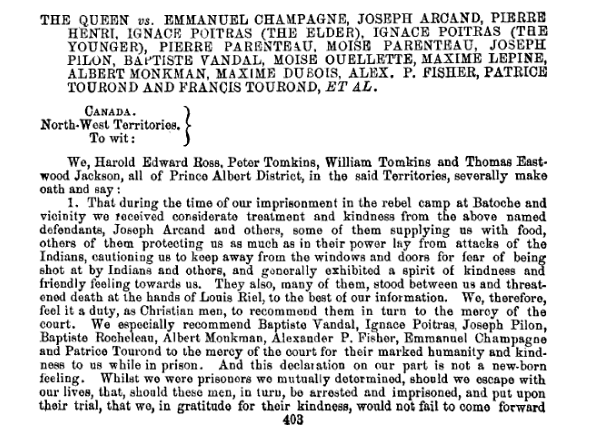
I have posted here before about Emmanuel Beaugrand dit Champagne. Luckily for me I was contacted by a distant relative (hey there Susan) who also has him in her tree. She gave me some information about him and I was able to find a copy of the text she quoted.
These are Sessional papers from the Government of Canada regarding his character after the Northwest Resistance/Rebellion.
Emmanuel was taken in leg irons and handcuffs as seen here after the battles. What to do when you may be executed for taking part in a fight to protect your land and families. Were they coerced into participation by threats? Damned if you do and damned if you don't I guess.
What I do know by reading this is that regardless of his position during the fighting he tried to be a decent human being.
NAMES OF OTHERS IN THIS DOCUMENT: Joseph Arcand, Pierre Henri, Ignace Poitras (the elder), Ignace Poitras (the younger), Pierre Parenteau, Moise Parenteau, Jospeh Albert Monkman, Maxime Dubois, Alex. P. Fisher, Patrice Tourond and Francis Tourand.
Showing posts with label METIS. Show all posts
Sunday, November 7, 2010
Thursday, September 17, 2009
SHARING RESEARCH
I received a comment in a previous genealogy post from Kathleen in Western Australia. She had done a search for a family name and it brought her to my site. Now I did have the names of the people she had searched for in my tree as they were my great great grandparents. What I did not have was the line she was searching for.
I did a few preliminary searches in the usual places and still wasn't finding anything. When dealing with Metis history the best place to go when you are stumped is Our_Metis_Roots@yahoogroups.com where you will find the most informed researchers. They constantly amaze me with the information they have collected and they are always ready to share.
Rod MacQuarrie came up with the answers both Kathleen and I were looking for and he did it in about 60 seconds. I have seen him respond so many times to others questions with very detailed and well sourced records. He includes everything on the people in question. Parents, children, military records, work records. You name it. Rod is not the only person in this group that jump to answer questions. There are many others doing great research and sharing it generously.
I always say genealogists are the most generous people always willing to help a fellow researcher.
I did a few preliminary searches in the usual places and still wasn't finding anything. When dealing with Metis history the best place to go when you are stumped is Our_Metis_Roots@yahoogroups.com where you will find the most informed researchers. They constantly amaze me with the information they have collected and they are always ready to share.
Rod MacQuarrie came up with the answers both Kathleen and I were looking for and he did it in about 60 seconds. I have seen him respond so many times to others questions with very detailed and well sourced records. He includes everything on the people in question. Parents, children, military records, work records. You name it. Rod is not the only person in this group that jump to answer questions. There are many others doing great research and sharing it generously.
I always say genealogists are the most generous people always willing to help a fellow researcher.
Saturday, September 5, 2009
FRANCOIS JACQUES BRUNEAU
Francois Jacques Bruneau is my 3rd. great grandfather also in my mother's line. Francois was a child of a "a la facon du pays" union between Antoine Bruneau and an Aboriginal woman, likely Cree. This refers to a union "as was the custom of the country" where there was likely no religious sanction of the marriage due to the remote areas where they lived and the non-catholic wives. He was born in December of 1809 in Lac Vert, Saskatchewan or Rupert's Land as it was called.
Francois was not baptized at the time of his birth but traveled to Quebec with his father when he was 4 years old and was baptized on October 28, 1814 in the Basilique Notre Dame, Montreal.
In 1822 Francois was in the Red River Settlement in Manitoba and was attending a school directed by Abbe Jean Harper. He was going to enter the priesthood which made the Bishop Joseph Norbet Provencher especially happy because Francois spoke Cree and could be very helpful in dealing with the aboriginals. In 1829 he changed his mind and became a teacher instead.
He married Marguerite Harrison, also Metis, in 1831 and left teaching for farming. The census reports for the area during the 1832-1849 span show his assest growing steadily. He and Marguerite had 8 children that I know of but others say they had 11.
He became considerably well off in comparison to others in the area at the time. His interests turned to civic affairs and in July of 1843 he appeared before the Council of Assiniboia to request a distillery giving the Metis somewhere to sell their grain surpluses as well as requesting changes to the police force at the time. These requests were granted.
Bishop Provencher urged the governor of Rupert's Land to name French Canadians and Metis to the Council of Assiniboia and had him look at Francois qualifications. He was recommended as "a man of sound standing in the settlement of fair education". This was again to facilitate relations with the Metis, French and Aboriginals.
In the fall of 1850 he was named as a magistrate in one of the judicial districts and in 1851 was made a judge. He earned between 12 and 25 British pounds for his service yearly.
Francois Jacques Bruneau died June 26, 1865 during the typhoid epidemic followed two days later by his wife, Marguerite.
Note that the age for Francois say 55 years. It is hard to read and looks like 3s.
Francois was not baptized at the time of his birth but traveled to Quebec with his father when he was 4 years old and was baptized on October 28, 1814 in the Basilique Notre Dame, Montreal.
In 1822 Francois was in the Red River Settlement in Manitoba and was attending a school directed by Abbe Jean Harper. He was going to enter the priesthood which made the Bishop Joseph Norbet Provencher especially happy because Francois spoke Cree and could be very helpful in dealing with the aboriginals. In 1829 he changed his mind and became a teacher instead.
He married Marguerite Harrison, also Metis, in 1831 and left teaching for farming. The census reports for the area during the 1832-1849 span show his assest growing steadily. He and Marguerite had 8 children that I know of but others say they had 11.
He became considerably well off in comparison to others in the area at the time. His interests turned to civic affairs and in July of 1843 he appeared before the Council of Assiniboia to request a distillery giving the Metis somewhere to sell their grain surpluses as well as requesting changes to the police force at the time. These requests were granted.
Bishop Provencher urged the governor of Rupert's Land to name French Canadians and Metis to the Council of Assiniboia and had him look at Francois qualifications. He was recommended as "a man of sound standing in the settlement of fair education". This was again to facilitate relations with the Metis, French and Aboriginals.
In the fall of 1850 he was named as a magistrate in one of the judicial districts and in 1851 was made a judge. He earned between 12 and 25 British pounds for his service yearly.
Francois Jacques Bruneau died June 26, 1865 during the typhoid epidemic followed two days later by his wife, Marguerite.
Note that the age for Francois say 55 years. It is hard to read and looks like 3s.
Friday, July 10, 2009
METIS HOME IN THE RED RIVER SETTLEMENT
This picture is of a home in the Red River Settlement of Manitoba. It was taken in 1870. I do not know who is in the photo. Even if they were not related to me they certainly knew my family. The cart in the picture was a Red River cart made with wood and tied together with leather. The squeal of the leather and wood made a sound that could be heard for miles. It was very stable with two large wheels that would maneuver through marsh and mud and was also buoyant enough to float across a stream.Image by inkbase via Flickr
The windows of the home were of course small. Glass was a luxury and also the Manitoba winters were beyond harsh.
Source: Archives of Manitoba/Archives du Manitoba, Red River Settlement - Homes 1, N4611
Year: 1870
Tuesday, June 30, 2009
FRANCOIS JACQUES BRUNEAU
Francois Jacques Bruneau was my GGG Grandfather. The following information comes from Dictionary of Canadian Biography Online.
BRUNEAU, FRANÇOIS-JACQUES, magistrate and councillor of Assiniboia; b. December 1809 at Lac Vert (Green Lake, Sask.), illegitimate son of Antoine Bruneau and a pure Cree or a Métis; d. 26 June 1865 at Saint-Boniface (Man.).
The father of François-Jacques Bruneau was probably a voyageur for the North West Company; he seems to have been related to Bruneaus prominent in Quebec society and also to Julie, wife of Louis-Joseph Papineau*. Since François-Jacques’ grandparents came from Poitou, he was of recent European origin, which was not common among the Métis. Those who could referred to themselves as grandchildren of “Frenchmen from France” in an effort to achieve equal footing with their half-breed compatriots, who were mostly of recent Scottish or English ancestry.
In 1814 François-Jacques Bruneau went to Montreal with his father, where he was baptized on 28 October, and in 1822 came to the Red River Settlement. He registered in the Saint-Boniface school directed by Abbé Jean Harper; it became a classical college the following year. In 1827 he indicated a wish to enter the priesthood, news that could only please Bishop Joseph-Norbert Provencher* because of Bruneau’s ability to speak the Cree language. But in 1829, when he was in first year, the first student of the college to reach that level, he decided to become a teacher. He married Marguerite Harrison, daughter of a Cree mother and a North West Company employee, probably in 1831, and abandoned teaching for farming. The censuses of Assiniboia between 1832 and 1849 indicate how his family, his property and livestock, and his carts for the transport trade, all increased. Eleven children were born to him; one of his sons, Athanase, served as a guide to Lord Milton [Wentworth-Fitzwilliam*] and Dr Walter Butler Cheadle* in 1862.
By 1849, in terms of Assiniboia, Bruneau was well off. He had also become involved in civic affairs. In July 1843 he had appeared before the Council of Assiniboia as a leading Métis in a delegation requesting a distillery (which would give the Métis an opportunity to sell their grain surplus) and regular changes in the police force (so that more of them might share in the running of the country). The return of Louis Riel Sr from Lower Canada during the summer of 1843 took the attention away from Bruneau until 1849. Bruneau did act as honorary deacon in 1845 at the ordination into the priesthood of Alexandre-Antonin Taché*, later bishop and archbishop of Saint-Boniface, but he took such a minor part in events at this time that he even stood aloof from the attempt to obtain the dismissal of Adam Thom*, the francophobe recorder of Rupert’s Land and councillor of Assiniboia. Bruneau was in a way typical of the Métis educated at Red River, who always remained diffident in the presence of the whites or half-breeds educated elsewhere. He was conciliatory, like the other Métis eventually named to the Council of Assiniboia, and easily influenced by established authority, civil or religious.
Bruneau rallied to the Métis in the spring of 1849 when, with the arrest of Pierre-Guillaume Sayer* for infringing the Hudson’s Bay Company’s commercial monopoly, their discontent reached its climax. Bruneau joined a vigilance committee. He alone among its members sat on the jury at Sayer’s trial, although Riel was more in the public eye. Bruneau did not, however, sign the petition presented to the Council of Assiniboia in May 1849 after the trial requesting the removal of Thom and the appointment of a bilingual recorder and of French speaking Canadians and Métis to the council. Still he was one of two French Canadians and three Métis, “men of common sense able to judge soundly,” recommended for appointment to the council by Bishop Provencher and approved by the Métis at a large gathering prior to their summer hunt. George Simpson*, the governor of Rupert’s Land, did not share the bishop’s opinions, however, and the company in London hesitated when he spoke of illiterates. Only Abbé Louis-François Laflèche* was made a councillor, in July 1850.
At this time, Bishop Provencher once again urged upon Simpson the importance of naming French Canadians and Métis to the council. Simpson, then at Red River, looked more carefully at Bruneau’s candidacy, and finally recommended him to the London authorities as “a man of sound standing in the settlement & of fair education” whose appointment would promote peace among “the Canadian Half-breeds [who] form a very large proportion of the inhabitants, and feel that they are not put on a footing of equality with the other classes in the community.” In 1851, Simpson’s suggestion received the support of Eden Colvile*, the governor of Rupert’s Land, who also desired the appointment of Bruneau, among others, as a means of balancing the clerical element in the council.
Bruneau had been named magistrate in one of Assiniboia’s judicial districts in the fall of 1850, and in 1851 was made its president or judge. On 29 March 1853 he finally took the oath as councillor of Assiniboia, the second French speaking layman after Cuthbert James Grant* to do so. He soon occupied a variety of posts paying annual salaries between £12 and £25, including that of judge in several districts. He attended council regularly but was not a vocal member.
According to contemporaries, Bruneau was approachable and courteous. A man of simple tastes, he liked to read books borrowed from the library of the HBC or of the bishop. On two occasions he defended his tutor, Bishop Provencher, in the Nor’Wester when it did not sufficiently recognize his contribution as an educator and civilizing influence in Red River. Bruneau always had great respect for Provencher and his successor, Taché, although he did not always share their attitudes in civil matters; he disapproved, for example, of Taché’s stand in council for a duty on alcoholic beverages to curb their importation. Bruneau, who knew how to conciliate the more powerful, proposed and got accepted an amendment to exempt imports from Britain.
Bruneau died in 1865, a victim of a typhoid epidemic in the colony that also killed his wife. In 1870 only three of their daughters and one of their sons were living. He had served the authority of the HBC faithfully, without harming the interests of his Métis compatriots but also without contributing greatly to their political, social, or economic advancement.
Lionel Dorge
ACAM, RLB, 2, p.54. Archives de l’archevêché de Saint-Boniface (Man.), Notes de Mgr Cloutier sur les commencements de l’histoire religieuse de ce pays. Cours donnés les jeudis par Mgr Taché à partir du 15 décembre 1881 à la fin de mai 1882; Registres des baptêmes, mariages et sépultures, paroisse Saint-Boniface, 1825–35, 28 juin 1865. Archives de la Société historique de Saint-Boniface (Man.), Dossier François Bruneau. Archives de l’évêché de Trois-Rivières, Correspondance Taché-Laflèche, 18 juill. 1865. HBC Arch. D.4/23, 5 Jan., 21 April 1838; D.4/70, 30 June 1849; D.4/71, 9 May, 2, 5 July 1850; D.5/25, 27 June 1849; D.5/34, 16 Aug. 1852; E.5/6, ff.3d.–4; E.5/7, ff.19d.–20; E.5/8, ff.3d.–4; E.5/9, ff.4d.–5; E.5/10, ff.4d.–5; E.5/11, ff.3d.–4 (mfm. at PAC). PAC, MG 9, E3, 1–3. Les bourgeois de la Compagnie du Nord-Ouest: récits de voyages, lettres et rapports inédits relatifs au Nord-Ouest canadien, L.-F.-R. Masson, édit. (2v., Québec, 1889–90; réimpr. New York, 1960), I, 59, 400. Canadian North-West (Oliver), I, 38–39, 63, 66–67, 80, 307, 352, 361, 368, 389–555. J. J. Hargrave, Red River (Montreal, 1871), 349. HBRS, XIX (Rich and Johnson), lxxxiii–lxxxv, xc, cxiv, 208. [J.-N. Provencher], “Lettres de Monseigneur Joseph-Norbert Provencher, premier évêque de Saint-Boniface, Manitoba,” Soc. historique de Saint-Boniface, Bull., III (1913), 94, 120, 122, 127. Nor’Wester, 14, 28 Feb., 14, 28 April 1860; 1 April, 14 Sept. 1861; 6 July, 3 Aug. 1865. Morice, Dict. historique des Canadiens et Métis, 53–54. Giraud, Le Métis canadien, 902–3, 905–63. Ross, Red River Settlement (1957), 239. A.-H. de Trémaudan, Histoire de la nation métisse dans l’Ouest canadien ([Montréal, 1935]), 135. F.-J. Audet, “François Bruneau,” BRH, XXXVII (1931), 274–78, 600–1. J.-J. Lefebvre, “La vie sociale du grand Papineau,” RHAF, XI (1957–58), 483–84. [Louis] Mailhot, “François Bruneau,” Les Cloches de Saint-Boniface (Saint-Boniface, Man.), XLV (1946), 69–72.
BRUNEAU, FRANÇOIS-JACQUES, magistrate and councillor of Assiniboia; b. December 1809 at Lac Vert (Green Lake, Sask.), illegitimate son of Antoine Bruneau and a pure Cree or a Métis; d. 26 June 1865 at Saint-Boniface (Man.).
The father of François-Jacques Bruneau was probably a voyageur for the North West Company; he seems to have been related to Bruneaus prominent in Quebec society and also to Julie, wife of Louis-Joseph Papineau*. Since François-Jacques’ grandparents came from Poitou, he was of recent European origin, which was not common among the Métis. Those who could referred to themselves as grandchildren of “Frenchmen from France” in an effort to achieve equal footing with their half-breed compatriots, who were mostly of recent Scottish or English ancestry.
In 1814 François-Jacques Bruneau went to Montreal with his father, where he was baptized on 28 October, and in 1822 came to the Red River Settlement. He registered in the Saint-Boniface school directed by Abbé Jean Harper; it became a classical college the following year. In 1827 he indicated a wish to enter the priesthood, news that could only please Bishop Joseph-Norbert Provencher* because of Bruneau’s ability to speak the Cree language. But in 1829, when he was in first year, the first student of the college to reach that level, he decided to become a teacher. He married Marguerite Harrison, daughter of a Cree mother and a North West Company employee, probably in 1831, and abandoned teaching for farming. The censuses of Assiniboia between 1832 and 1849 indicate how his family, his property and livestock, and his carts for the transport trade, all increased. Eleven children were born to him; one of his sons, Athanase, served as a guide to Lord Milton [Wentworth-Fitzwilliam*] and Dr Walter Butler Cheadle* in 1862.
By 1849, in terms of Assiniboia, Bruneau was well off. He had also become involved in civic affairs. In July 1843 he had appeared before the Council of Assiniboia as a leading Métis in a delegation requesting a distillery (which would give the Métis an opportunity to sell their grain surplus) and regular changes in the police force (so that more of them might share in the running of the country). The return of Louis Riel Sr from Lower Canada during the summer of 1843 took the attention away from Bruneau until 1849. Bruneau did act as honorary deacon in 1845 at the ordination into the priesthood of Alexandre-Antonin Taché*, later bishop and archbishop of Saint-Boniface, but he took such a minor part in events at this time that he even stood aloof from the attempt to obtain the dismissal of Adam Thom*, the francophobe recorder of Rupert’s Land and councillor of Assiniboia. Bruneau was in a way typical of the Métis educated at Red River, who always remained diffident in the presence of the whites or half-breeds educated elsewhere. He was conciliatory, like the other Métis eventually named to the Council of Assiniboia, and easily influenced by established authority, civil or religious.
Bruneau rallied to the Métis in the spring of 1849 when, with the arrest of Pierre-Guillaume Sayer* for infringing the Hudson’s Bay Company’s commercial monopoly, their discontent reached its climax. Bruneau joined a vigilance committee. He alone among its members sat on the jury at Sayer’s trial, although Riel was more in the public eye. Bruneau did not, however, sign the petition presented to the Council of Assiniboia in May 1849 after the trial requesting the removal of Thom and the appointment of a bilingual recorder and of French speaking Canadians and Métis to the council. Still he was one of two French Canadians and three Métis, “men of common sense able to judge soundly,” recommended for appointment to the council by Bishop Provencher and approved by the Métis at a large gathering prior to their summer hunt. George Simpson*, the governor of Rupert’s Land, did not share the bishop’s opinions, however, and the company in London hesitated when he spoke of illiterates. Only Abbé Louis-François Laflèche* was made a councillor, in July 1850.
At this time, Bishop Provencher once again urged upon Simpson the importance of naming French Canadians and Métis to the council. Simpson, then at Red River, looked more carefully at Bruneau’s candidacy, and finally recommended him to the London authorities as “a man of sound standing in the settlement & of fair education” whose appointment would promote peace among “the Canadian Half-breeds [who] form a very large proportion of the inhabitants, and feel that they are not put on a footing of equality with the other classes in the community.” In 1851, Simpson’s suggestion received the support of Eden Colvile*, the governor of Rupert’s Land, who also desired the appointment of Bruneau, among others, as a means of balancing the clerical element in the council.
Bruneau had been named magistrate in one of Assiniboia’s judicial districts in the fall of 1850, and in 1851 was made its president or judge. On 29 March 1853 he finally took the oath as councillor of Assiniboia, the second French speaking layman after Cuthbert James Grant* to do so. He soon occupied a variety of posts paying annual salaries between £12 and £25, including that of judge in several districts. He attended council regularly but was not a vocal member.
According to contemporaries, Bruneau was approachable and courteous. A man of simple tastes, he liked to read books borrowed from the library of the HBC or of the bishop. On two occasions he defended his tutor, Bishop Provencher, in the Nor’Wester when it did not sufficiently recognize his contribution as an educator and civilizing influence in Red River. Bruneau always had great respect for Provencher and his successor, Taché, although he did not always share their attitudes in civil matters; he disapproved, for example, of Taché’s stand in council for a duty on alcoholic beverages to curb their importation. Bruneau, who knew how to conciliate the more powerful, proposed and got accepted an amendment to exempt imports from Britain.
Bruneau died in 1865, a victim of a typhoid epidemic in the colony that also killed his wife. In 1870 only three of their daughters and one of their sons were living. He had served the authority of the HBC faithfully, without harming the interests of his Métis compatriots but also without contributing greatly to their political, social, or economic advancement.
Lionel Dorge
ACAM, RLB, 2, p.54. Archives de l’archevêché de Saint-Boniface (Man.), Notes de Mgr Cloutier sur les commencements de l’histoire religieuse de ce pays. Cours donnés les jeudis par Mgr Taché à partir du 15 décembre 1881 à la fin de mai 1882; Registres des baptêmes, mariages et sépultures, paroisse Saint-Boniface, 1825–35, 28 juin 1865. Archives de la Société historique de Saint-Boniface (Man.), Dossier François Bruneau. Archives de l’évêché de Trois-Rivières, Correspondance Taché-Laflèche, 18 juill. 1865. HBC Arch. D.4/23, 5 Jan., 21 April 1838; D.4/70, 30 June 1849; D.4/71, 9 May, 2, 5 July 1850; D.5/25, 27 June 1849; D.5/34, 16 Aug. 1852; E.5/6, ff.3d.–4; E.5/7, ff.19d.–20; E.5/8, ff.3d.–4; E.5/9, ff.4d.–5; E.5/10, ff.4d.–5; E.5/11, ff.3d.–4 (mfm. at PAC). PAC, MG 9, E3, 1–3. Les bourgeois de la Compagnie du Nord-Ouest: récits de voyages, lettres et rapports inédits relatifs au Nord-Ouest canadien, L.-F.-R. Masson, édit. (2v., Québec, 1889–90; réimpr. New York, 1960), I, 59, 400. Canadian North-West (Oliver), I, 38–39, 63, 66–67, 80, 307, 352, 361, 368, 389–555. J. J. Hargrave, Red River (Montreal, 1871), 349. HBRS, XIX (Rich and Johnson), lxxxiii–lxxxv, xc, cxiv, 208. [J.-N. Provencher], “Lettres de Monseigneur Joseph-Norbert Provencher, premier évêque de Saint-Boniface, Manitoba,” Soc. historique de Saint-Boniface, Bull., III (1913), 94, 120, 122, 127. Nor’Wester, 14, 28 Feb., 14, 28 April 1860; 1 April, 14 Sept. 1861; 6 July, 3 Aug. 1865. Morice, Dict. historique des Canadiens et Métis, 53–54. Giraud, Le Métis canadien, 902–3, 905–63. Ross, Red River Settlement (1957), 239. A.-H. de Trémaudan, Histoire de la nation métisse dans l’Ouest canadien ([Montréal, 1935]), 135. F.-J. Audet, “François Bruneau,” BRH, XXXVII (1931), 274–78, 600–1. J.-J. Lefebvre, “La vie sociale du grand Papineau,” RHAF, XI (1957–58), 483–84. [Louis] Mailhot, “François Bruneau,” Les Cloches de Saint-Boniface (Saint-Boniface, Man.), XLV (1946), 69–72.
Friday, June 5, 2009
EMMANUEL BEAUGRAND DIT CHAMPAGNE
(L-R):IgnacePoitras, Pierre Parenteau, Baptiste Parenteau, Pierre Gariepy, Ignace Poitras Jr., Albert Monkman, Pierre Vandal, Baptiste Vandal, Joseph arcand, Maxime Dubois, James Short, Pierre Henry, Baptiste Tourond, Emmanuel Champagne, Kit-a-wa-how (Alex Cagen-ex chief of the Muskeg Lake Indians) Taken Aug 1885, Regina, Saskatchewan by O.B. Buell. Taken from the Canadian National Archives.
The rebellion was a culmination of discontent of the Metis, Aboriginal and White settlers which had gone on for some time.In 1866 the government started the surveying of lands in and around the Red River Settlement. This of course became a source of tension. This was the Metis and Indians land and the government was coming in and drawing lines on it. Louis Riel spoke in August of 1869 to call the Metis to organize themselves against this.
The problems continued for some years with Louis Riel eventually suffering mental exhaustion which in 1876 saw him admitted to a psychiatric hospital in Quebec. He then went to the US where he became an American citizen in 1883.
There were several battles through the years. Duck Lake saw a skirmish between the Metis and the RCMP. Duck Lake was the only clear victory for the Metis. The Frog Lake Massacre saw whites and Metis in the community killed or taken hostage as sympathizers with the Cree led by Big Bear. Fish Creek, Cut Knife Hill, Frenchman's Butte were also unsuccessful for the Metis although the death tolls were thwarted by the ability of the Metis to retreat through the muskeg where the militia could not pursue them.
The Battle of Batoche was the end. For four days- May 9-12, 1885 less than 300 Metis and First Nations people led be a returning Louis Riel and Gabriel Dumont sought to defend themselves from the troops.
On the first day the troops sought to attack by coming across the river on a steamer ferry. The Metis simply lowered a ferry cable across the river cutting off the smokestacks of the steamer and it floated downstream without power. They then defended their postitions with gunfire until daybreak. Over the next couple of days the gunfire was returned by the troops with bigger weaponry. The ammunition stores of the Metis were running low by this time.
On May 12 some of the troops attacked from the north drawing the Metis out of their rifle pits signalling to the remaining men to attack from their position. The winds were loud and on the side of the Metis and the remaining troops did not hear the attack signal and failed to attack on time. This was not enough of a setback for the troops however. A third contingent came in from the side and broke through the lines. The battle was over in minutes. The Metis ammunition was gone and they were firing nails and stones from their rifles. Louis Riel escaped with Dumont. Riel gave himself up and was later hanged. Dumont fled to the US.
This is how my Great Grand Uncle, Emmanuel Beaugrande dit Champagne ended up in the photograph above, in handcuffs and leg irons. He is I believe the second man from the right in the front row. He was one of the twelve counselors or exovede (latin: flock) of the Riel government during the North West Rebellion in 1885
Emmanuel and his family were enumerated in the 1850 census of the Minnesota Territory, in which Emmanuel declared that he was a hunter.He was born about 1823 in Pembina, North Dakota and died in Batoche, Saskatchewan September 29, 1904.He was married to Marie Letendre dit Batoche
In the 1854 treaty list of Chippewa Indians of Lake Superior and the Mississippi, he is listed as a mixed blood of the Pembina band who had lived at Saint Joseph (Walhalla, N. D.) for over ten years.
Emmanuel fought for his rights and the rights of the other Metis and it could have cost him his life and his freedom.
Subscribe to:
Posts (Atom)